Reading the Fine Print of a Character Description
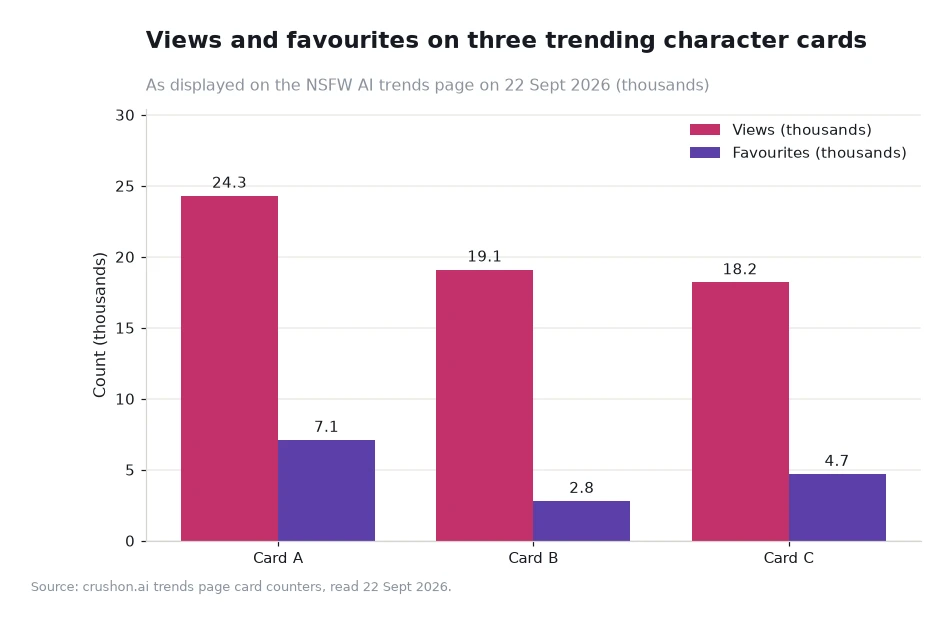
A character description is the only part of a card you can test before you commit any time to it, and most readers skim it in four seconds. The three cards on the trends page illustrate the cost of skimming: 24.3M, 19.1M and 18.2M views against 7.1K, 2.8K and 4.7K favourites, three very different save rates hiding behind three similar-looking headlines.

Key takeaways
- Four lines carry most of the information: who the character is, how they speak, what situation opens, and what the first exchange looks like.
- Tags are filterable and comparable; prose is specific and readable. A card with both is easier to judge than a card with either.
- Save rates differ far more than view counts: 7.1K out of 24.3M is 0.029%, while 4.7K out of 18.2M is 0.026% on a smaller audience.
- A description predicts a starting point, not a whole relationship — long-run behaviour depends on how the character adapts as you write.
The four lines that do the work
Nearly every card opens with a persona sentence: a name, a role, a temperament. That sentence is doing more than decoration. It sets the register the replies will be written in, and it is the fastest thing to reject — if the persona is not interesting in one line, a longer description rarely rescues it.
The second line is voice. Cards describe interaction style rather than dialogue, which is the practical part: formal or casual, brief or verbose, teasing or earnest. The platform builds its characters around distinct personalities, appearances and interaction styles, and the interaction-style clause is the one that determines how a session actually feels to read.
The third line is the situation — where the conversation begins and what the character already knows about you. The fourth is often implied rather than written: how the first exchange opens, and whether the card invites you to set the scene or sets it for you. When those two are vague, you will spend the first ten messages discovering the premise instead of enjoying it.
Tags versus prose
Tags are structured and therefore comparable. They let you line up three cards and see immediately which ones share a register — Unfiltered, Submissive, Fictional, OC, Female and similar labels recur across Crushon's catalogue of NSFW AI characters and inside search. Prose is unstructured and therefore specific. A tag tells you a card belongs to a category; a sentence tells you what the category means in this particular case.
The useful signal is agreement between the two. When a card's tags and its description point in the same direction, the trail paragraph usually behaves the way you expect. When they diverge — a soft tag on a hard premise, or an elaborate description with one generic label — the mismatch is worth treating as a warning, because you are about to spend time discovering which half is accurate.
| Element | What a careful reader looks for | What it predicts |
|---|---|---|
| Persona sentence | A concrete role and temperament in one line | The register replies will be written in |
| Interaction style | Pace and tone rather than plot | How conversational the session feels minute to minute |
| Opening situation | A stated place and starting point | How much scene-setting you have to supply yourself |
| Tags | Labels that match the prose | Whether the card is findable through search filters |
| Creator credit | A maker whose other cards you can inspect | Whether the quality is likely to repeat across a catalogue |
Worked example
Compare the three cards by the number that matters rather than the number that photographs best. Card A: 7.1K favourites divided by 24.3M views is 0.0292%, which is about 29 keepers for every 100,000 people who opened it. Card B: 2.8K divided by 19.1M is 0.0147%, roughly 15 per 100,000. Card C: 4.7K divided by 18.2M is 0.0258%, about 26 per 100,000.
Read those three rates side by side and the ranking flips. Card B sits second on views but last on savers per thousand readers, less than two thirds of Card C's rate. Card C has the smallest view total of the three and the middle position, yet it converts almost as well as the leader. That gap is what a well-specified description buys: the people who open the card already know what they are getting, so fewer of them walk away.
Turning a description into a shortlist
Work in a fixed order and the process takes a few minutes. Read the persona line first and discard anything that does not spark. Read the interaction style next and check that it matches the tags. Only then read the opening situation, and only for cards that survived the first two passes. Most readers do this in the opposite order, which is why so much time goes into promising premises that are dull to actually write with.
If you want a pool of candidates rather than one, keep a shortlist of three or four from the ai nsfw chart and open them in order of how well their description scored, not how high they rank. When a card fails, note which line failed. A pattern emerges quickly — usually that you want a specific interaction style rather than a specific premise — and once you know that, you can search on it directly instead of browsing.
One more habit is worth the effort. If a description promises something that later turns out to be inaccurate, the platform treats each content page as reportable and accepts reports by email as well; the details sit in the content removal policy. Descriptions that overclaim are a quality problem for the whole catalogue, so reporting them is a small contribution rather than a complaint.
Filtering does the same work at scale. Once you know the interaction style you want, the character search page narrows the catalogue to cards that already match it, and the descriptions attached to those results are usually written for an audience that arrives with a preference. That is the difference between browsing a chart and consulting an index: one asks what is popular, the other asks what fits.
Frequently asked questions
Does a longer description mean a better character?
Not necessarily. Length helps only when it adds specificity about voice or situation. Many strong cards are specified in three precise lines.
Which line should I read first?
The persona sentence, then the interaction style. Those two decide whether the card is worth your time; the opening situation matters only after they pass.
Why do save rates differ so much between cards?
Partly because of fit and partly because of expectation. A clear description filters out readers who would not have enjoyed the card, which raises the share of those who keep it.
Make the description do the filtering
Treat the card text as a filter you control rather than a sales pitch you tolerate. Four minutes of careful reading per card, applied to three cards instead of twelve, produces a better evening and a shorter list. Re-read the first line of anything you saved a month ago; if it still reads clearly, the description was doing its job.
Figures in this piece come from the trends page card counters, read 22 Sept 2026[1]; the keep-rate percentages are arithmetic on those counters. Read 22 Sept 2026. This article is written for an 18+ audience.